
Seated burials are uncommon.
This one has archaeologists scratching their heads.

Around the world, and especially here in Australia, burial customs vary. Many Aboriginal people traditionally buried people in a ‘flexed’ or ‘bundle’ burial position, others placed people on platforms in trees then reburied them elsewhere, some buried people on their backs, legs and arms extended.
Seated burials, however, are very rare.
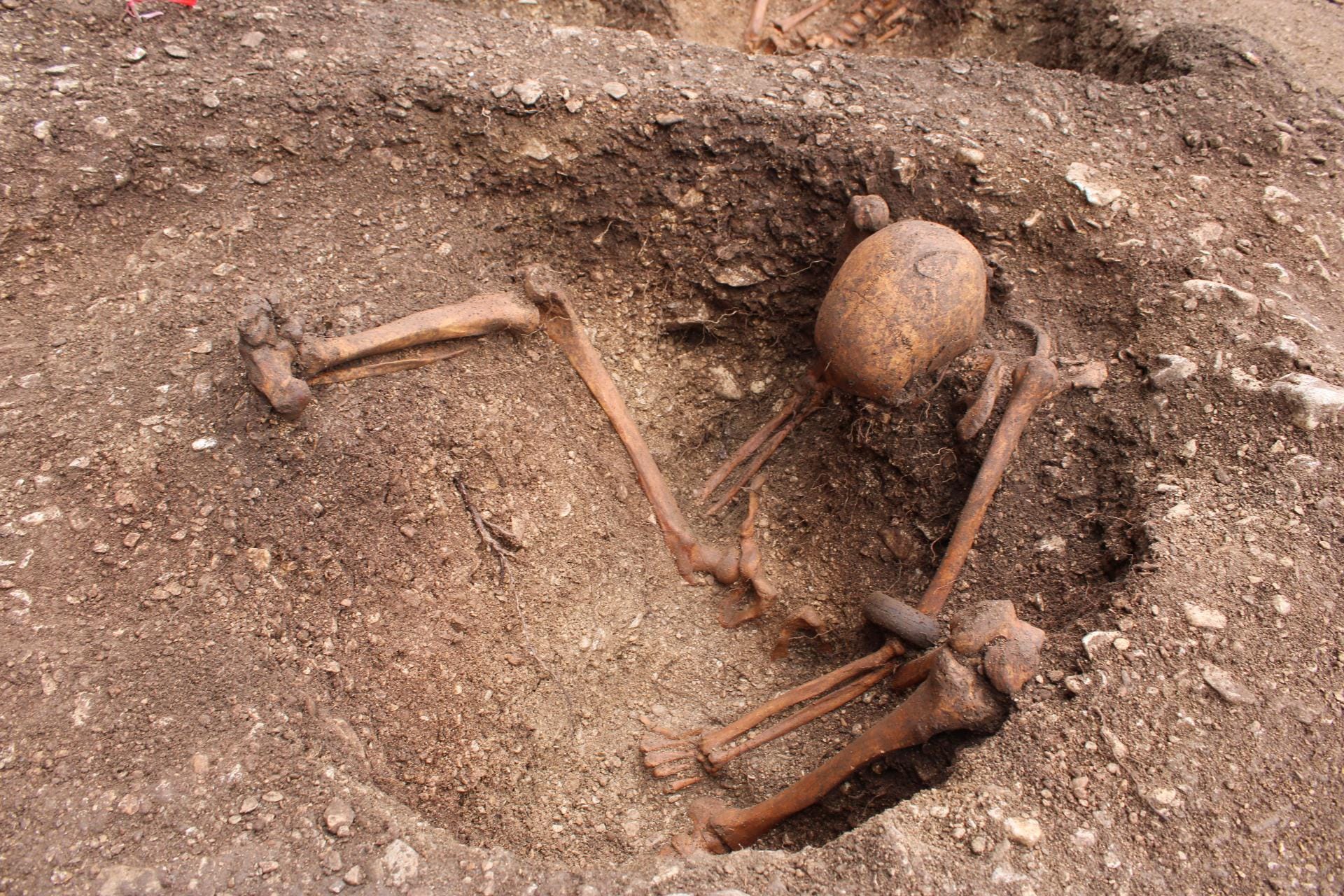
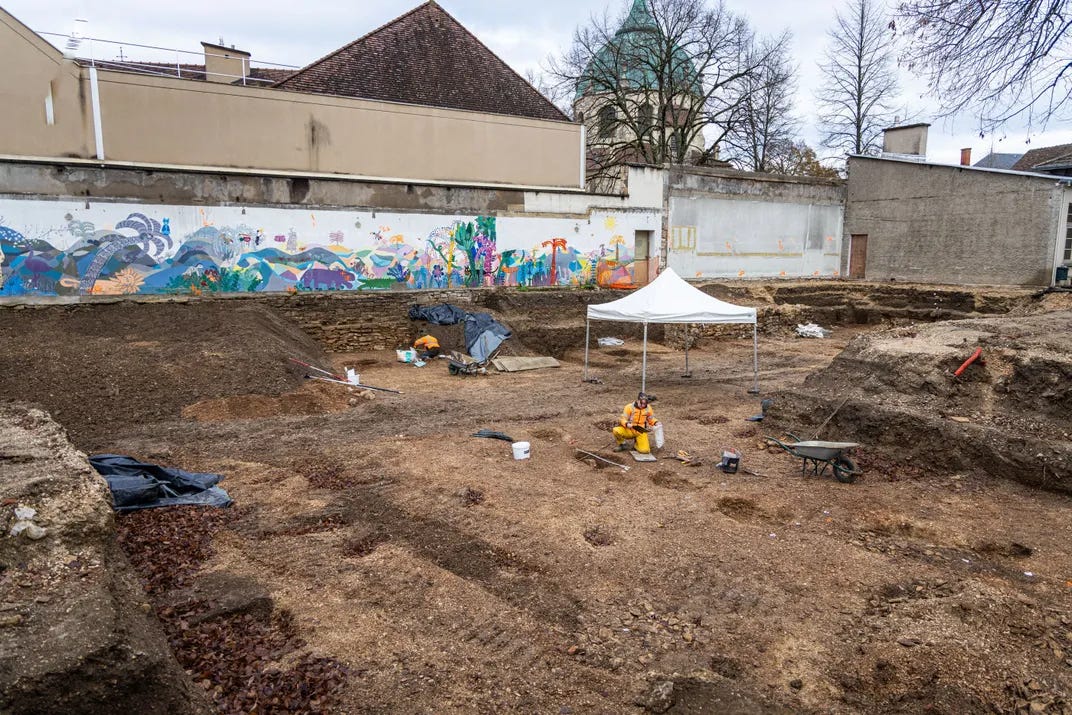
In Europe and the UK, only 75 examples of seated burials (people buried sitting upright) have ever been found. In February 2026, archaeologists working on a construction site in Dijon, France, announced they’d discovered 13 seated burials. The burials, initially discovered in 2024, were located in the front garden of a former convent, now a children’s playground.
They weren’t the first burials to be found at the site.
In the western portion of the site, archaeologists found a burial ground dating from the Gallo-Roman period, the 1st century AD. This area contained the 22 burials of individuals less than one year old, suggesting that this space was dedicated to the burial of very young children. All of the children were buried in manner common for the time, laid out on their backs or sides.
The 13 individuals are all adult males. All placed the same way: lowered into narrow pits, backs against the eastern wall, knees drawn up, hands resting near the pelvis. Their faces were deliberately turned west. Most of them have unhealed cut marks on the arms, suggesting wounds from edged weapons. One man likely died from two deep blows to the head.
Further osteological analysis revealed that the men were all aged between 40 to 60 years, in good health, with robust limbs and good dentition. Their heights ranged between 1.62 m and 1.82 m.
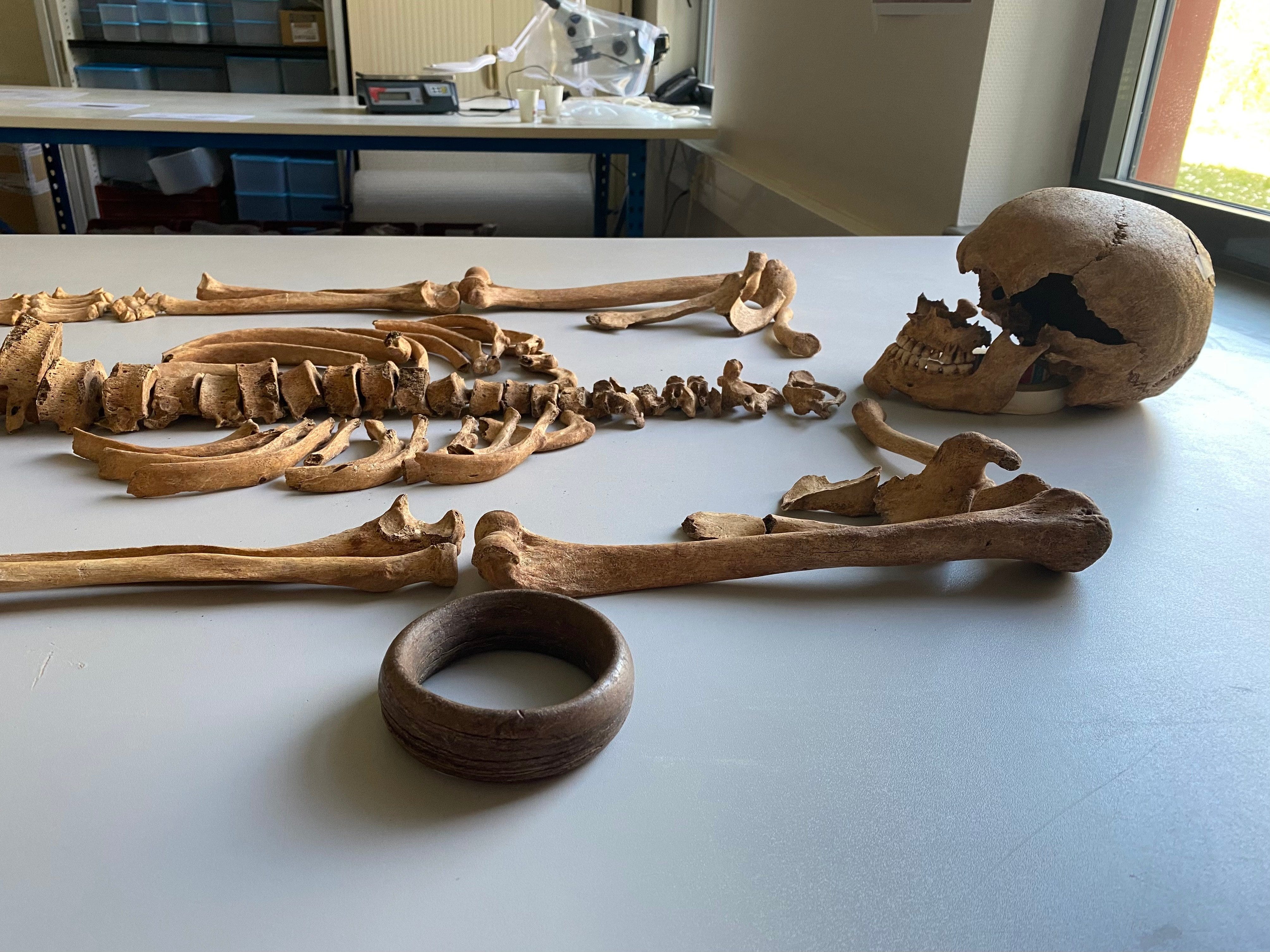
The graves are evenly spaced. There’s almost nothing buried with them—no grave goods, no obvious markers of identity, just the one stone armband (pictured above) was found across the entire group. The stone armband allows for a cross-check of the site’s dates, associated with Gaulish people around 300 to 200 BCE.
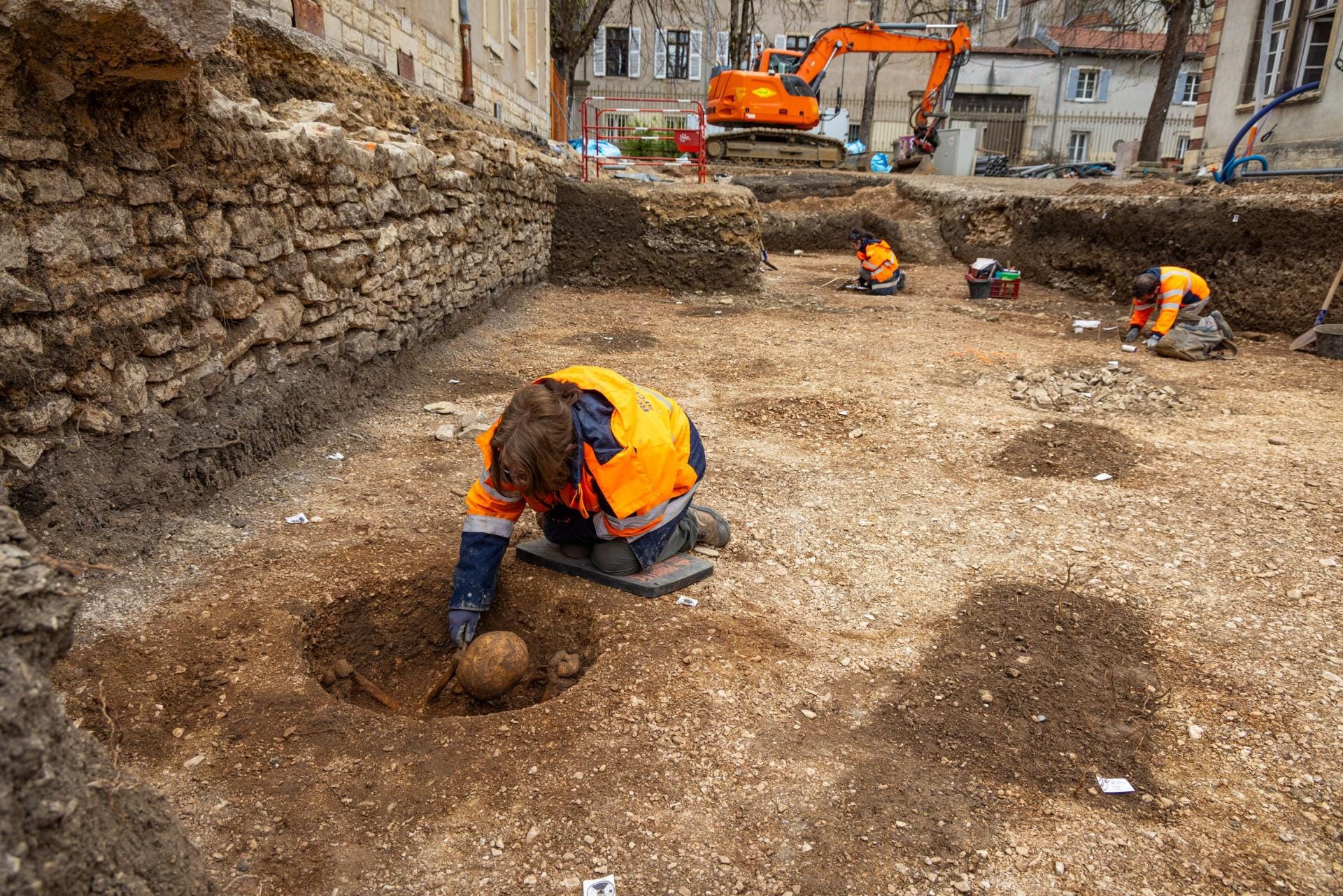
Further dating of the site confirmed that it is over 2,000 years old, dating to the Late Iron Age, between 450 and 25 B.C.E. Other Gaulish burials of the time have been documented as being buried on their backs or cremated.
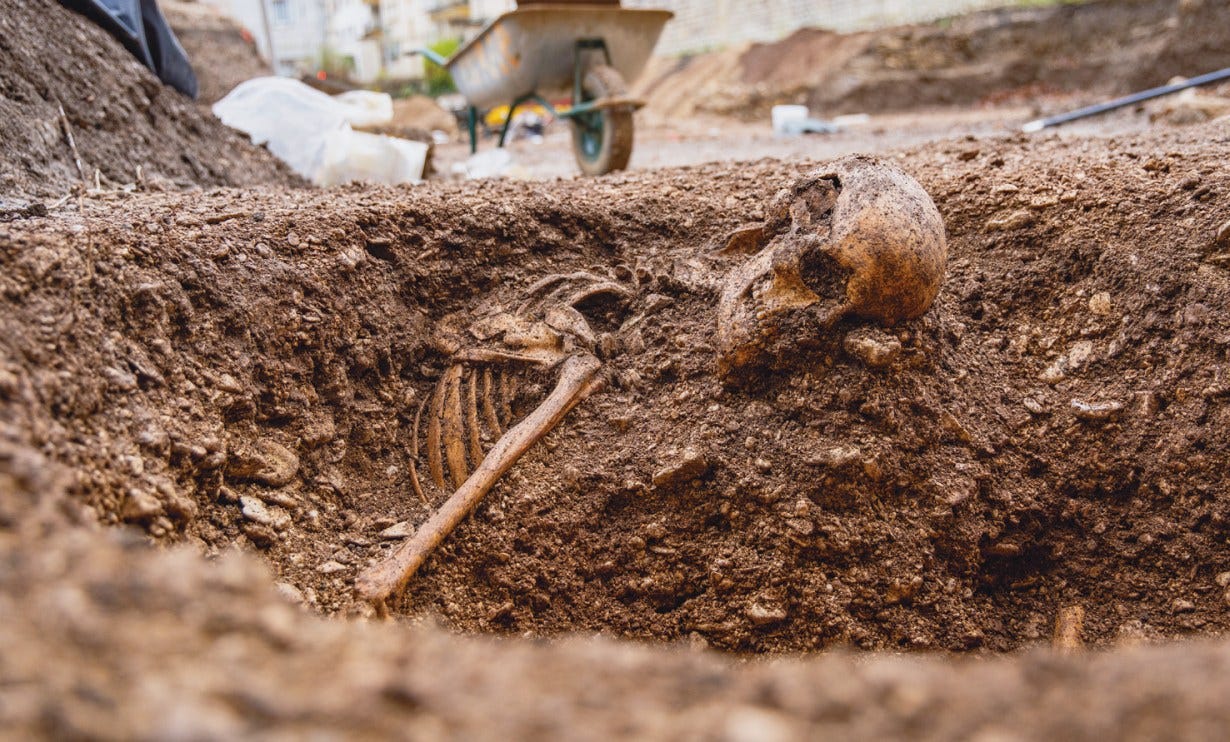
The positioning of the 13 men really does have we archaeologists scratching our heads.
Back in 2017, archaeologists Valérie Delattre and Laure Pecqueur took stock of every known example of these strange seated burials. The result was…well, not many. Just nine sites across France and three in Switzerland—in all around 50 skeletons. And tellingly, none of them turned up in formal cemeteries. Instead, they cluster at the margins—near what look like high-status residences or places of ritual activity.
At the very mention of ritual, I can feel the eye rolling spasms of 1000s of archaeologists across the world. It’s a professional in-joke that everything we don’t understand about human behaviour in the past is umm…ritual.
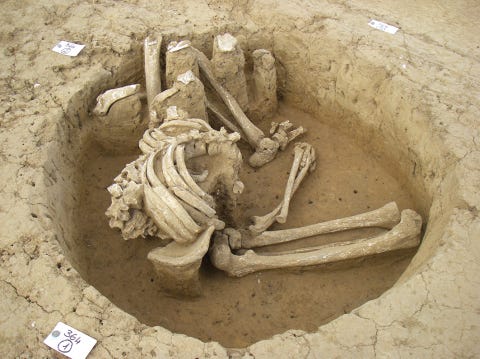
But is this ritual? Could it simply be disgrace? After all, unusual burials elsewhere in the ancient world have indicated punishment—or even practices associated with warding off evil.
Earlier rescue excavations led by Laurent Pelletier in 1992—less than 100 metres from the Dijon site near the Joséphine Baker school—hint that this wasn’t an isolated practice. At the nearby Fyot residence, two more seated burials were uncovered and attributed to the Gallic period, though frustratingly, never radiocarbon dated.
A second excavation, slightly further west at the St-Anne car park, turned up something even stranger: a tightly grouped deposit of animals—28 dogs (mostly young males), five sheep, and two pigs. All were laid out along a north–south axis, heads to the north. The assemblage was studied by archaeozoologist Patrice Méniel, who drew comparisons with similar finds at Vertault—a site interpreted as a place of cult activity in the final phase of the Gallic period.
But there’s a problem that will feel painfully familiar to anyone who works with legacy data: none of the Dijon animal remains were ever radiocarbon dated. Which means we’re left with a pattern that looks meaningful—but can’t be securely tied to the 13 seated individuals just down the road.
Why were these men buried in this way? Were they prisoners from a rival Gaullish tribe? Honoured warriors? Members of an upper class elite? Inrap archaeo-anthropologist Annamaria Latron suggests we may never know:
“We do not have a preferred hypothesis. We’re missing the surface layer, which was above the tombs.”
“Being an archaeologist can be a very frustrating profession,” she added.
I can agree with Annamaria. As I tell both my younger colleagues and clients: archaeology is all about expecting the unexpected.
Further reading:
Actualité | Des Gaulois inhumés assis rue Turgot à Dijon (Côte-d’Or) 2026 March 18 Inrap. Retrieved 20 April 2026 < https://www.inrap.fr/des-gaulois-inhumes-assis-rue-turgot-dijon-cote-d-or-19785 >.
Alterauge, A., T. Meier, B. Jungklaus, M. Milella, and S. Lösch 2020 Between belief and fear - Reinterpreting prone burials during the Middle Ages and early modern period in German-speaking Europe. PLOS ONE 15(8):e0238439.
Archaeology, W. 2025 March 18 Unusual Gallic Burials: Excavating Bodies Seated in Pits | The Past. Retrieved 20 April 2026 < https://the-past.com/feature/unusual-gallic-burials-excavating-bodies-seated-in-pits/ >.
Delattre, V. and L. Pecqueur 2017 « Entrer dans l’immobilité » : les défunts en position assise du second âge du Fer. Gallia 74(2):1–17.
France-Presse, A. 2026 March 18 Ancient Skeleton Unearthed in France Is Latest to Be Found Sitting Upright. The Guardian.
Méniel, P. 2007 Les animaux de la nécropole gallo-romaine de Vertault (Côte d’Or, France).
Pelletier, C & C Bioul-Pelletier 1993 «Le parking Sainte-Anne et la résidence Fyot (Dijon, Côte-d’Or), fouilles archéologiques en 1992. Document final de synthèse (DFS), SRA Bourgogne / AFAN, Dijon.