
Too Many Browser Tabs
The Loss of Deep Focus & Can We Actually Do Anything About it?

I’ve got three articles sitting in my draft folder. There’s one in particular that should be easy to write as it’s simply expanding an old Twitter thread. I’ve even got the images loaded in the post.
But every time I go to polish it—EVERY SINGLE TIME—I just can’t.
My muse refuses to do anything. My muse is a dead, inaccessible…
Void.
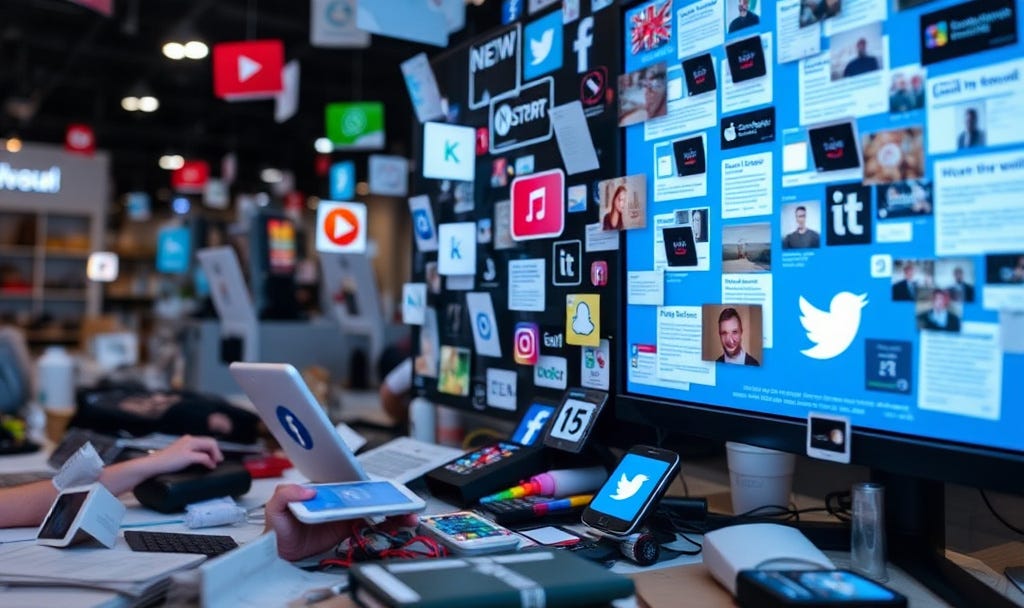
Instead, I check my email, my social media, open another browser tab. Then another and another, and launch myself down rabbit holes, side quests, and let’s not forget PINGPINGPING—the work group chat lights up with someone needing extra buckets on Stage 36.
When I look up, two hours of my life have slipped by, never to be seen again.
The article I should have written just sits there. Unfinished.
Worse, I can’t kick, slap or force my muse awake. She seems dead to me.
I can no longer flick on my lifelong superpower—creativity—and lose myself for 3 hours in my own head, pondering, thinking and imagining.
I’ve always told stories in my head, be it writing fiction (yep, I’m published), constructing essays like this or revising academic prose.
So I sit, staring into the abyss wondering If I can ever come back to myself.
On losing my mind
I know I’m not alone here.
I’m not the only one who’s noticed their ability to focus on reading academic articles—of focusing on anything deep—is shot to the shithouse. I’m not the only person to find I’ve spent hours scrolling funny Instagram reels after dinner when I before, I would have been reading.
And I’m not the first person to feel like I’ve lost my mind, my brain, my creativity to the online world.
I hate it.
I hate myself for ending up here.
I should be the exception.
Me, who has no trouble walking or running 10 kilometres every day.
Me who doesn’t eat donuts (blechhhh), fast food or drink soft drinks (that’s soda/sweet fizzy drinks for non-Australians. I’ve never had a can of Coke in my whole life!).
Me, who is now 70 days into quitting alcohol for 90 days. Happy to say I will only be returning to drinking once a week or on social occasions.
These are all things that other people find hard, but I find easy.

In other words, I clearly don’t lack will power or the ability to change myself.
But in this I feel utterly powerless to change.
So why did I (and just about everyone I know) fall victim to this?
More importantly, HOW DO I GET MY MIND BACK?
Darth Insidious
I think it started back when I created my first Wordpress blog back in 2007.
Innocuous, something to share my thoughts about books, yoga and anthropology resulted in me needing multiple browser tabs open to learn CSS and/or write posts.
I think—although I can’t really say for certain—this was the start: multiple browser tabs.
That year, I joined Facebook. In 2008, I joined Twitter.
I’m going to say that by 2012, my husband remarked on the number of browser tabs I had open. It was about 3 or 4. Nothing serious.
Now, it’s not unusual for me to have 15 tabs open in one browser. I don’t even notice. If I’m on my work laptop, I have to have their browser open as well to access company systems. This means another 7 tabs on average. That’s 22 tabs and I don’t even notice. It’s become normalised, unremarkable. I occasionally pause long enough to feel guilty, but then I searched to see what the average number of open tabs was and found it’s pretty normal. Some people have hundreds.
As I write this, the other internet-induced change that jumped out at me is paragraph length.
At the very base level of online communication, we’re funnelled towards the short and shallow. We’re drilled to keep sentences and paragraphs short and maximise white space when writing online. That’s a big NO to Charles Dickens or Tolstoy-length sentences. Apparently, people online can’t parse long sentences. Worse, if you do write longer, multi-clause sentences or use the em dash*, you’ll be accused of using AI. And heaven forbid anyone use an AI for anything. The writing girlies on Threads and Insta will make you character of the day. Should you be lucky enough to be MAIN character of the day everywhere, you’ll get your own dotpoint in Lady Whistlethreads’ weekly newsletter.
*That scream you hear is Gen-X rage: you will prise the em dash out of our cold, dead hands.
We can add to this smartphones. I think I started with an iPhone 3 or 4. I honestly can’t remember, and again, that’s scary in itself. I haven’t have that many iPhones (I own an iPhone 13 mini at present). I tent to replace batteries long before I replace phones. But where I can effortlessly remember every car I’ve owned over the past 40 years, I am at a loss to remember every iPhone of the handful I’ve owned.
Why is that so, when these devices are now ubiquitous?
And, is it not supremely ironic that not being able to recall how many and what model iPhones I’ve owned illustrates exactly what I’m getting at here: the contemporary loss of focus.
This loss of mind, of self, of who I believe myself to truly be.
What started with just two or three tabs open is now a memory black hole the size of Tasmania and an inability to focus for more than 2 minutes.
FOMO & Contemporary Malaise
There’s something here to add about the cultural shifts I’ve lived through. In my lifetime, we’ve gone from records, to cassettes, to CDs, to MP3s and now streaming.
It’s not just the technology. You have to be online—banking, health, personal identification have all gone digital and show no signs of coming back. If you don’t participate, you don’t exist, which locks you into more scrolling, more shallow interactions and more time with a screen.
There’s no escape at work, either. Teams, emails, Sharepoint, Slack, Whatsapp, every damned online HR/KPI app. Everything is online, increasingly gamified and cloud-based. For many of us Australian archaeologists, remote area fieldwork with no phone reception was a blessing—but now Elon has ensured that text messages can even reach you out there.
Until recently, being able to be reached 24/7 and being constantly online was not a thing. We had down times, spaces in the day or week where your mind could defrag, wander, be shielded from constant input and novelty. Where you could savour moments of boredom and unexpected flow. These moments were often hidden in the minutiae of everyday life; unacknowledged mental breaks of routine tedium, of writing application forms, queuing to make transactions, of walking without music, going out to buy a cassette, waiting for a dial-up modem to connect. These have all slipped, unnoticed, into oblivion.
Fuzzed
A few days ago, it all came to a head for me.
Or rather, it came to a head in my head.
I’d spent a couple of post-birthday days learning how to use a new eink note-taking device. A lot of time online, watching, reading, cramming, and fiddling. At the same time, a literature review for a human osteology project lurked over my shoulder, as well as the coming week’s work tasks.
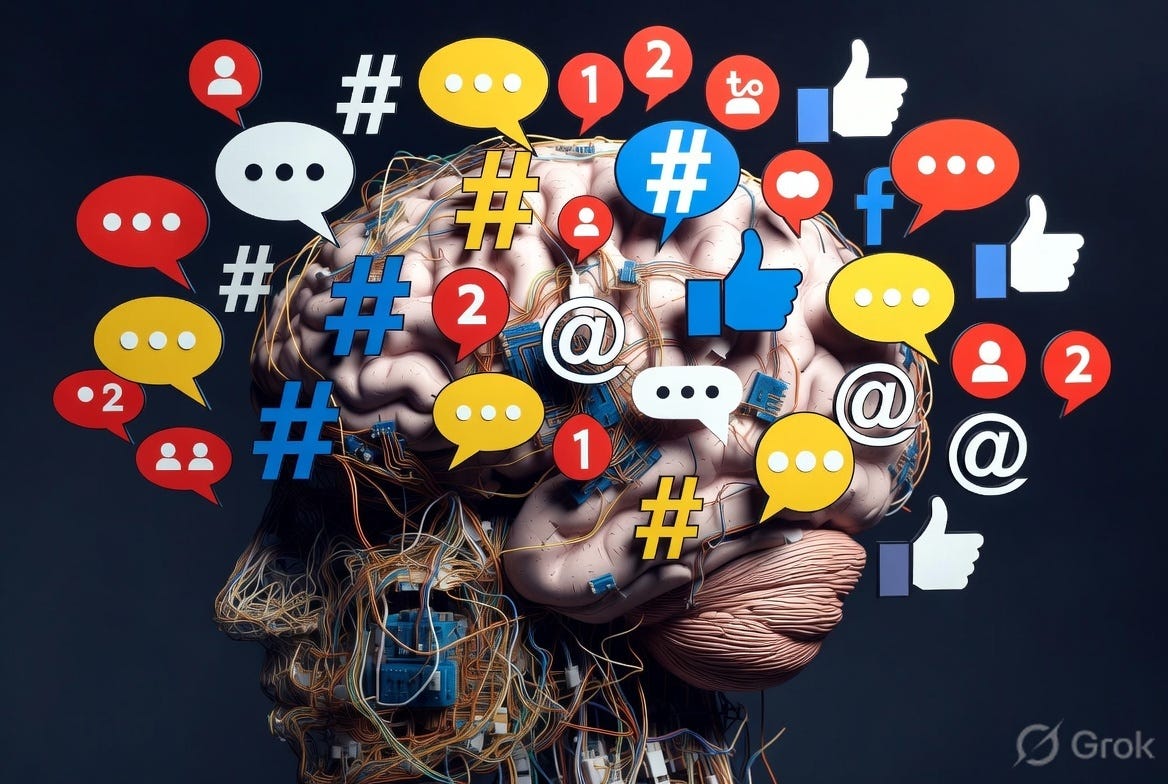
The moment I tried to read and write for the lit review, my brain fuzzed.
Fuzzed?
The exact feeling was like a mouse running on a treadmill. An endless, fast-turning cog that took up my entire mental capacity, leaving no ability to engage with anything else. This isn’t just a metaphor. I’m talking an actual, physical whirring inside my head.
The more I tried to read, think and write, the louder the cog whirred.
I’m sure a neuroscientist will have a word for this, but I can only think of it as overwhelm. My brain threw up a shield and said: NO MORE.
Can I Reinstall Me?
It’s not possible to go back to the version of me that existed in my undergrad days, where I spent years in flow states, reading, thinking, writing.
In those days, as well as being an undergrad, I was a gym instructor and paid my way through uni doing that, and my kids were small. I gardened a lot. We didn’t have a lot of money, the internet was dial up and mobile phones were bricks.
I’m now in a senior position in the company I work for, can’t just stop using the internet or my work phone.
What is possible, I think, is to do the thing I did with alcohol—abstain. I’ve found that it takes me about 8 weeks to build a habit. Apparently, the addiction to screens and information aka novelty is a dopamine addiction, just like the need to have alcohol everyday. If my lack of focus and ability to think deeply are the result of too much screen input/information overwhelm and my neurones are addicted to the dopamine, then I should be able to stop that addiction.
It’s not realistic to stop using my smartphone or the internet completely. As I’ve said above, the world is different. It’s almost impossible to go completely analogue, and I’m not sure that I want to.
But I can be clear about what I do want: I want my focus and creativity back.
To do that, I need less cognitive input and more cognitive space.
Action Steps
I actually don’t want an entire strategy. I just want simple friction that will drive me away from the phone and constant feed of info into my brain to change the dopamine reward cycle.
So, I’ve started by downloading the Dumbphone app. It’s made my phone ugly and makes me use it in dark mode which I despise. Yes Gen-Z, I hate your dark mode. It’s butt ugly and migraine-inducing. However, there’s now a whole lot of friction to finding my fave apps.
So 8 weeks with a butt-ugly phone. That’s 15/06/2026.
Next is focus and boredom.
I will prioritise activities (reading, writing, gardening) that require longer attention and re-start thinking walks I used to always do.
Will this reclaim my focus and creativity? Let’s try it and see. If nothing else, I’ll be able to finish and publish the articles in my drafts.